Politics and Ballet? Catching Up With the Washington Ballet’s New Artistic Director Edwaard Liang

This article appears in the February 2024 issue of Washingtonian, and is available on the Washingtonian website here.

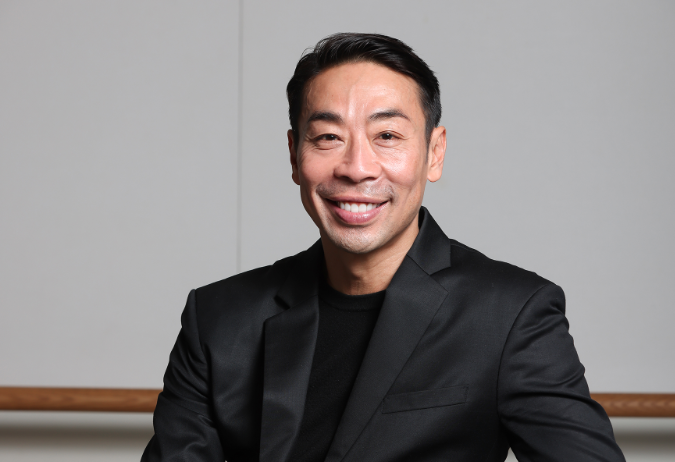
This spring, the Washington Ballet will welcome its new artistic director, Edwaard Liang, a highly regarded choreographer who has created works for many of the world’s major ballet companies. What does he hope to bring to DC’s most prominent ballet institution? We recently called him up to get acquainted.

These days it can feel like the world is on fire. What do you see as the role of dance right now?

I have been thinking about this lately. There are always going to be turbulent times. When you look at history, where it seems like the world is on fire—that’s where artists and art really step forward. To not only entertain but also to touch, move, and inspire. And to reflect our humanity back. When the world is most difficult, that’s when art is most essential.

Does your Chinese American identity impact your work as a ballet-­company leader?

I’m the first Asian American artistic director of a ballet company of this size. I think that representation is very powerful for our industry, and part of how dance is changing. And it absolutely impacts my craft and how I lead because who I am is a culmination of my experiences. Not just being genetically Chinese but how I was raised by two Chinese immigrant parents, my culture, history, and sense memory.

What do you think is the relationship between dance and politics?

I really don’t know that answer, and I’m excited to learn. I was commissioned to choreograph a ballet for the opening concert at Davos some years ago. [Conference organizers] felt if these world leaders could be inspired by performance, they would make inspired choices. So from the vantage point of where I’m at and just slowly entering into the Washington ecosystem, that’s my answer.

What do you hope to bring to DC as an arts leader?

My charge is to bring the community into conversation with dance and art. And what I hope to accomplish is to make the Washington Ballet a unique company that has its own unique repertoire, complementary to the ecosystem at large. I have a perspective. But my charge is to bring what is going to catch, move, and inspire the community.

What are some dances that you’re most excited to bring to the area?

You know, a beautiful part of my job is that it’s trying to answer that question. I’m such a foodie. What is your favorite thing to eat? What I love about being artistic director is it’s not looking at one particular program or ballet. I love variety. It’s like a tasting menu of 20 courses.

The Utopia Project Aims to Empower

This article was published January 21, 2023 by Washington City Paper, available online on their site here.

The Utopia Project, on display through March 1 at the Smithsonian Anacostia Community Museum, is a brilliant example of what happens when a museum dismisses the top-down model for exhibition development. It lists no single curator, or director, and was created in a collaboration between the museum’s associate director of education, Andrea Jones, staff of the museum, and the New York-based Center for Artistic Activism, which helps develop and sustain artistic activism.

The exhibit, which is also described as an “interactive gallery experience,” presents a framework designed to empower arts activism. Up since November, the project fits in neatly with the museum’s longstanding mission to tell the stories of the everyday people who’ve used their voices to bring about change and equity. As the museum’s director, Melanie Adams, said in an emailed statement to City Paper, “programming like The Utopia Project continues the museum’s decades-long tradition and centers around each person’s potential for creative action in their communities.”

Some of the museum’s history is on display within The Utopia Project, including a panel showing Georgia Mills Jessup, the museum’s first artist in residence from 1968–1970, who painted murals on walls adjacent to the museum as part of the area’s People’s Park. Another panel features the story of local poet Rhozier “Roach” Brown, who was part of a 1970 Anacostia Museum exhibition event that explored experiences of incarceration.

Asantewa Boakyewa, deputy director of the museum, supported collection of the two very large artworks in the display in her prior position as associate director of collections and exhibitions. In an interview with City Paper, Boakyewa described the exhibition’s unusual development trajectory, saying, “The traditional exhibit, particularly at the Smithsonian, is usually heavily guided by research. With exhibitions, generally, it is field-specific disciplines that the curator is using to identify the methodology for the research. [For The Utopia Project] gallery experience, we wanted to be clear to delineate that this is not an outgrowth of an academic or research question or inquiry, but that it’s an immersive experience.”

The serpentine path created by the partial and temporary exhibition walls is layered with artworks, interactives, and histories that teach the viewer about arts activism. Wall text asks attendees to pick up a “Dreambook” shortly after walking in, and the space includes stations with stickers, ink stamps, a virtual reality interactive, and tables with access to crayons and Legos.

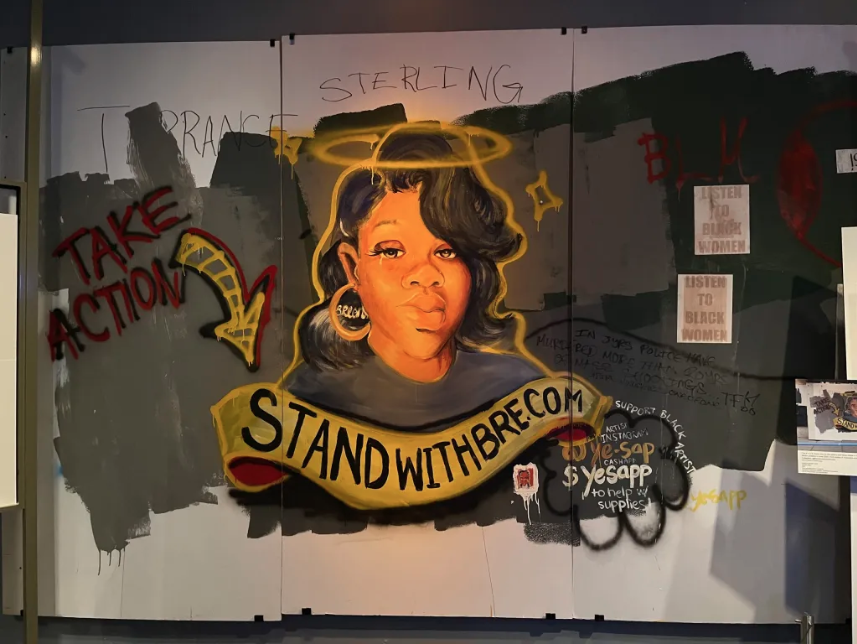
A pair of larger colorful artworks the museum recently acquired are centered: a mural honoring Breonna Taylor by Yetunde Sapp, and a crocheted Black Lives Matter mural that originally hung in Lafayette Square during the summer of 2020 by London Kaye. These powerful street artworks—protesting the extrajudicial execution of Black Americans—are a complicated backdrop for the open-ended imagining of a “utopia,” due to the brutality that the Black Lives Matter movement seeks to put an end to. But by centering these works in The Utopia Project, the museum affirms the importance of the protest and the experiences of Black Americans.

Sir Thomas More (1477–1535) coined the word utopia to describe a place with a shared culture by combining Greek words meaning “no place” and “a good place.” The use of the word in the exhibition’s title references Dr. Martin Luther King Jr.’s effort to describe a world that does not yet exist. Instead, the exhibition’s design asks visitors to engage in play-driven imaginings of utopia while immersing themselves in history via examples from very adult campaigns

The Utopia Project describes the activist process as something co-created among communities, and it embodies the co-creation process, including works made by museum staff members and local artists Dwayne Lawson-Brown and Maps Glover. A video of poet Lawson-Brown performing ends the exhibit; earlier visitors come across an interactive piece by visual artist Glover. This piece, using a QR code via smartphone camera apps, conjures an imaginary being, which seems to float in the gallery on one’s phone. Visitors can even capture a picture of themselves with it—just one example of technology allowing us to see a world as it does not currently exist. Glover’s is one of several technology-crafted artworks that ask visitors to interact with the exhibit—including a globe, which viewers are encouraged to physically leave a mark on with an ink stamp.

 “The collection’s objects that are in the show, as well as the historical examples that we call case studies in this experience are designed to support the interactivity,” says Boakyewa. “That is really what is most different about The Utopia Project.”

Some of the stories on display, like the recent Black Lives Matter protests that took over the city during the summer of 2020 following the murder of George Floyd, and the Don’t Mute DC protests, an ongoing response to gentrification in the city, are recent enough that viewers may already be familiar with them. But many are more arcane. For example, the show includes a panel on activist Julian Hobson, also known as a “hoaxmaster,” an east of the river resident who, in the 1960s, allegedly caught rats in his neighborhood and set them loose in Georgetown in an effort to get city officials to take action on pest infestation.

“Maybe we don’t think of museums being a place to empower residents, but it’s part of what the Smithsonian Anacostia Community Museum has always done,” says Nina Simon, a museum studies pedagogue and the author of The Participatory Museum, who is not connected to ACM. “This is in the DNA of the Anacostia Community Museum, to be a place that centers and pushes boundaries around activism, around localism, and around community voices having a place in the institutions.” 

This idea is shared by the Smithsonian. “Since its inception, the Anacostia Community Museum has been a model for how museums can be more than simply community centers but also powerful change agents at the center of their communities,” Smithsonian Secretary Lonnie Bunch said in a Nov. 7 press release announcing a $5 million gift from philanthropists Roger Ferguson and Annette Nazareth to establish an endowment supporting the museum’s director position.While clearly designed to delight younger children and teens, The Utopia Project is equally interesting for adults. Readers of George Orwell may not entirely envision a new world walking through the space, but it is hard to avoid some sense of rapture at the creativity and creative history on display. 

What the Departure of Julie Kent Means for the Washington Ballet

After seven seasons, the company’s artistic director heads to Houston, leaving many wondering what’s next for the local ballet company.

This article was written for and published by Washington City Paper.

On Oct. 21, the Washington Ballet announced that Julie Kent, its star artistic director, would leave the organization at the end of the current season to become the co-artistic director at Houston Ballet, a new role seemingly made for her. Her unexpected departure from TWB has obvious repercussions for the company and raises questions about its future.

“I had an opportunity that grew very organically and really made sense on a lot of levels. And it seems like a logical next step for me to work in probably one of the greatest ballet companies in this country, if not the world,” Kent tells City Paper regarding her decision to step away from TWB. “I’m just honored to have the opportunity to join that community.”

Kent is only the third artistic director of the Washington Ballet in its 55-year history. Her tenure, from 2016 to 2023, will be the shortest. Septime Webre was artistic director from 1999 to 2016, following the company’s founder, Mary Day, who was artistic director from 1967 to 1999. Kent confirmed that the opportunity and decision to accept Houston’s offer were sudden. “It came together very quickly,” she says, noting it happened this fall.

Kent’s recruitment to lead the Washington Ballet was heralded as a move that would help the company emerge onto the national stage. Kent was the longest-serving ballerina in the history of American Ballet Theatre, one of the world’s leading classical ballet companies. She performed principal roles in more than 100 classical and contemporary ballets while at ABT, and originated roles in works by Mark MorrisTwyla Tharp, and Stanton Welch (Houston Ballet’s artistic director, who will continue in the role alongside Kent). 

Kent is known in pop culture circles for her performance in the 2000 film Center Stage. But to those in the dance world, she is recognized as a ballerina of extraordinary accomplishment, discussed alongside dancers such as Suzanne FarrellNatalia Makarova and Sylvie Guillem. When Kent arrived in Washington, she brought a radiant star power that was undeniable. Her trajectory in some ways parallels Judith Jamison, the longtime artistic director of New York’s Alvin Ailey American Dance Theater, who was a highly celebrated performer before transitioning into leadership.

“Julie is known for the pursuit of excellence—not as a goal, but as an ongoing process,” Jean-Marie Fernandez, board chair of the Washington Ballet, tells City Paper. “Our entire organization has benefitted, and will continue to benefit, from this quintessentially ‘Julie’ mindset.”

While praise for Kent is uniform in the dance community, it’s not clear that the company has always risen to her expectations, or that audiences have been able to grasp her vision. Prior to assuming leadership of TWB, Kent had no experience as a company director: She retired as a performer with ABT in 2015, one year before taking the job here. Her husband, Victor Barbee, associate artistic director of ABT from 2001 to 2016, however, was hired for the same role under Kent at TWB. (Barbee will also be departing TWB at the end of this season.) 

“The directors brought in some new dancers, but in fact, they polished the whole company,” says Sarah Kaufman, who has reviewed TWB’s productions for years as chief dance critic for the Washington Post. “Julie and her husband Victor staged truly handsome productions of GiselleSleeping BeautySwan Lake, and the dancers stepped up to the challenges of that.”

Alastair Macaulay, chief dance critic of the New York Times from 2007 to 2018, agrees the direction provided by Kent resulted in improvement in performances of classical ballets. “Under Kent, I was immediately impressed by changes for the better in the company’s classical style,” he tells City Paper. “The company was evidently acquiring a single, coherent vision of classical style.”

“After I retired … Kent, whom I had never met before, consulted me about Swan Lake, by email, as she was preparing her new production,” Macaulay says. “I gradually realized she was much better educated than most dancers (and than many critics) in the immense complexities of Swan Lake’s textual issues.”

Kent, in our interview, expressed gratitude for the acclaim her stagings of classical ballets have received and pointed to the company’s place in the community as part of her legacy. While there are a number of large theater companies in the region with their own buildings and staff, there is only one such professional dance company. TWB impacts and influences not only professional dance in D.C., but dance education as well.

“There’s so much that I’m proud of,” says Kent. “I am so proud of all the accomplishments that we have made on stage, as far as all the artistic and technical and just the comprehensive growth of the dancers.” Additionally, she pointed to the restructuring of the company’s education facility in Congress Heights, which she says is, “producing dancers that are going on to wonderful careers either professionally or in high-level college programs.” 

While classical ballets at TWB shined under Kent, some of the new works she commissioned were less well-received. Lisa Traiger, an independent dance critic and journalist who has been covering the field in the region for four decades, recalls a ballet commissioned from Kent’s former ABT colleague Ethan Stiefel to commemorate President John F. Kennedy’s space program with “ridiculous space suit costumes, an ugly set, and inconsequential choreography.” 

While Kent programmed some noteworthy new works, including pieces by Annabelle Lopez Ochoa, Traiger evaluates, “most of them were middling, unlikely to be seen in subsequent seasons, or move to other companies.” Kent’s predecessors, Webre and Day, while less accomplished than Kent in some ways, were lauded for their ability to recruit standout choreographers for the company, including Trey McIntyre and Choo San Gho, respectively.

Like many artistic leaders over the past few years, Kent’s time leading the company’s programming was significantly impacted by the pandemic. Of her seven seasons at TWB, one was canceled in its entirety by COVID-19 and another was entirely virtual. (Not to mention, her first season was spent producing performances programmed prior to her arrival.) 

Leading a dance company through a pandemic is much like coaching a team that’s never allowed to play. In a regular year, budgeting, season planning, and dancer development call for a skilled balancing act; being responsible for such areas of management during an unprecedented global pandemic is an additional level of difficulty. And there is uniform appreciation for the ways in which Kent navigated all of the challenges presented by COVID.

Now, with the company finally emerging into a more pre-pandemic rhythm, Kent’s decision to leave is another unexpected blow. Together Fernandez and Kent convened a special board meeting to share the news earlier this fall. Fernandez confirms the company is currently hiring a firm to assist the board committee in identifying candidates. An exact timeline for the hiring of the firm, let alone a new AD, was not confirmed.

The conclusion of each season is when dancers’ contracts are reviewed, renewed, and promotions considered. With Kent’s impending departure, it’s unclear who will handle those discussions, evaluations, and negotiations. However, Patrick Kennedy, the company’s managing director since August 2020, says, “Julie is with the Washington Ballet and fulfilling all artistic director responsibilities through the end of the 2022-23 season.”

The company has said little else about the transition. Now it prepares for its most important performance run of the year: 41 performances of The Nutcracker running Nov. 12 through Dec. 30. The holiday ballet is not just important for 2022, but TWB’s future. Theater and dance audiences have been slow to return and the box office success of this year’s Nutcracker run may be critical to the financial stability of the company. In her book Nutcracker NationJennifer Fisher writes that ticket sale revenue from The Nutcracker is commonly more than 50 percent of annual ticket sale revenues for U.S. ballet companies. TWB hopes this year’s production will bring a return to pre-pandemic sales, but it will have to do so while competing with a Nutcracker production from Kansas City Ballet at the Kennedy Center.

Kent’s departure from TWB creates an opportunity for the company to redefine its place in the community. “There is a certain amount of momentum that a company needs to be a part of a community,” Kent says. “I’m really optimistic and hopeful that the next director will be able to just continue to build on all that we’ve accomplished to date and continue to engender even greater enthusiasm and interest.”

Until the next director arrives, and following this season’s Nutcracker performances, audiences can enjoy a weekend of works by George Balanchine from Feb. 22 to 26, a family-friendly performance run of adapted classics from April 7 to 9, and a run of The Sleeping Beauty from May 4 to 7. Perhaps, by that last performance, a new artistic director will be waiting in the wings.